Ancient Six Healing Sounds Qigong
Six Healing Sounds Qigong: sound, breath and movement, from shadow emotion to light virtue.
Six traditional sounds, a tone for each, and music that carries the emotional journey.
A seven-day immersion inspired by Liu Zi Jue, the traditional Six Healing Sounds, for QiGong and TaiChi teachers and therapists who want to deepen their own practice and bring sound and music into their teaching.
The first immersion took place at the Leqita Summer Academy in 2025, and the second there in 2026. The next immersion is at the Leqita Summer Academy in July 2027, with more details to follow.
Join the mailing list and receive the free Six Healing Sounds Practice Guide (English and German) right away, plus early access when the next immersion opens.
Who it is for
QiGong and TaiChi teachers, therapists, and committed practitioners who want to work with sound as a living part of Qigong.
What the seven days contain
One organ, one sound and one emotion each day, with movement, breath, voice, visualisation and curated instrumental music. By Day 6 the full form comes together; Day 7 is integration.
Who shares it
I'm Raymond Hackland, and I practised for many years with Bob Lowey of Qigongtauk and the 7 Stars School of Taijiquan. The form I share in the immersion is my own.
The Practice
The Six Healing Sounds: six sounds, six organs, one breath
Each sound is linked to an organ and its emotion. Through gentle movement, conscious breathing, vocal resonance and visualisation, the practice cultivates balance, vitality and inner awareness.
Lungs · SSSSS · Tuning 741 Hz
Metal and the colour white: the sound supports the turn from grief toward courage.
Kidneys · CHOOO · Tuning 396 Hz
Water and deep blue: the sound grounds fear and cultivates wisdom.
Liver · SHHHH · Tuning 528 Hz
Wood and green: the sound releases the heat of anger and makes space for kindness.

Heart · HAAAA · Tuning 639 Hz
Fire and red: the sound softens impatience and opens toward joy.
Spleen · WHOOO · Tuning 852 Hz
Earth and gold: the sound gathers worry back into centeredness.
Triple Burner · HEEE · Tuning 963 Hz
The San Jiao joins the upper, middle and lower body, bringing what feels fragmented into harmony.
As a musician, I give each sound its own tuning. After the traditional form, we practise the sound again with a tone set to that pitch. I take the pitches from the modern Solfeggio set because I like how they sound together. The songs that follow are chosen for their emotional journey, from grief to courage for the lungs, not for their pitch. Choosing the tuning and the songs is part of my method, the way a composer chooses a key: an invitation to resonance, not a health claim.
Immersions
The Six Healing Sounds: a seven-day immersion
Each day of my immersions is one organ: the sound and its movement, then its tone, then lying down inside a music journey I've chosen, then the form again.
Seven sessions of 90 minutes. Each day focuses on one organ, one sound and one emotion, and each new day revisits the sounds already learned. By Day 6 the complete form is practised in sequence; Day 7 is given to integration and a practice circle. The Six Healing Sounds (Liu Zi Jue) are among the best-known qigong practices; this practice is inspired by and connected to them, not a replacement for them. The order of the days follows my own sequence, which differs from the standard 2003 Health Qigong form (liver, heart, spleen, lungs, kidneys, triple burner).
Each session moves through
· Gentle warm-up and grounding
· Breath awareness and mindfulness
· Organ-specific Qigong movement and sound
· Tone and music: a tone set to each sound's tuning, then songs chosen for each organ's emotional journey
· Reflection, embodiment cues and Neigong principles
· Group sharing, questions and journaling
🟣 Lived experience. On lungs day, after the music, I don't tell people what to expect. I simply ask: "What did you notice?" Most participants have told me they were moved, sometimes deeply, and some said something heavy around grief had loosened. Many described their chest as feeling fuller, more spacious and lighter as they breathed. I share this because it's what people told me they felt, in my immersions, in that moment. It isn't a study, it isn't a result I promise, and everyone's experience is different. It's not medical advice or treatment.
The arc of the week
· Day 1 Lungs, grief to courage
· Day 2 Kidneys, fear to wisdom
· Day 3 Liver, anger to kindness
· Day 4 Heart, impatience to joy
· Day 5 Spleen, worry to centeredness
· Day 6 Triple Burner, fragmented to harmony, and the full form
· Day 7 Integration and practice circle
What participants leave with
· The full Six Healing Sounds sequence, and the confidence to practise it on their own
· A clearer awareness of their emotional and energetic patterns
· Sound and breath as tools for daily self-care, including a 10–15 minute evening sound ritual
· A participant handout covering organ, element, colour, sound, acupuncture points, visualisation and a music playlist for each day
· A reflection journal template and, for teachers, session-by-session teaching notes
The first immersion took place at the Leqita Summer Academy in 2025, and the second there in 2026. Next immersion: Leqita Summer Academy, July 2027, more details to follow. Join the mailing list to hear first when booking opens.
About me
A living tradition, practised with care
Liu Zi Jue, the "Six Character Formula", is a breathing and sound practice rooted in Classical Chinese Medicine and Taoist philosophy. It goes back to the Dao Yin practices of Taoist monks, hermits and scholars. Breathing out on sounds is already mentioned in Daoist writings more than 2,000 years old. The six sounds were first written down between the 6th and 8th centuries. In 2003 China's General Administration of Sport issued a standardised "Health Qigong" version, compiled by its Health Qigong Management Center and now promoted by the Chinese Health Qigong Association (founded 2004). Today it is taught widely in China and around the world.
I approach the form as a practice of resonance. The traditional movements and sounds are joined with breathwork, Neigong principles and sequenced instrumental music, so that each sound is felt as a passage from shadow emotion toward light virtue.
Connected, not a replacement. This work draws on traditional Liu Zi Jue as its reference and inspiration. It is a personal, music-assisted interpretation, not a replacement for the classical form or for study with a qualified teacher of the tradition.
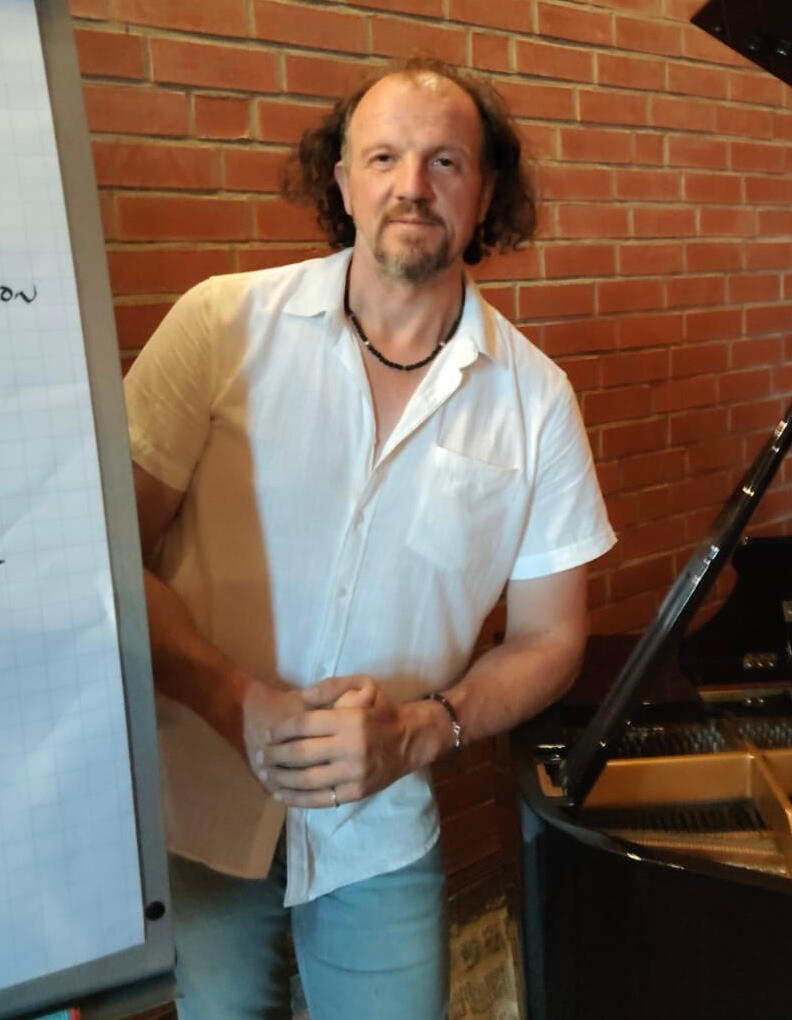
I'm a musician who shares qigong: I choose the tone and the songs so you can hear each organ's emotional change, and then we return to the form.
Musician. I'm a musician first, and a curious one. I trained in piano from an early age through Trinity College of Music, London, with my examinations taken in Glasgow. As an adult I taught myself guitar, songwriting, singing and mouth harmonica, and went on to have some commercial success as a solo artist, with chart and radio play and small European tours.
Years on stage taught me something I couldn't let go of: live sound does something to a room. Resonance and vibration move through an audience in ways you can feel before you can explain them. When I met the Six Healing Sounds, an ancient practice built on breath and sound, it felt like finding the other half of the experiment.
So that's what Resonance Heritage Qi is: my sound lab. I use Qigong as the bridge, and I pair each of the six sounds with carefully chosen music and a tuning of its own, exploring how tone, rhythm and pitch shape the way the practice feels. Part tradition, part curiosity, and always a little bit mad.
Lineage. I studied with Bob Lowey, Founder and Director of Qigongtauk (Qigong Teachers Association United Kingdom) and Founder and Principal Tutor of the 7 Stars School of Taijiquan (established 1985). Bob has been involved with Qigong and Chinese martial arts since the early 1970s and gained his Instructorship in 1979. In China he became an initiate of Grandmaster You Xuande (Wudang Pai), with further studies under the late Professor Zhang Guangde (Beijing), and in the UK with Sifu Gordon Faulkner.
As my teacher for many years, in Scotland and Germany, Bob has taught me several Qigong forms, including The Poem (形体诗韵, Xíngtǐ Shīyùn), Daoyin Yangsheng Gong (导引养生功, Dǎoyǐn Yǎngshēng Gōng), Daoyin Baojian Gong (导引保健功, Dǎoyǐn Bǎojiàn Gōng), the Tai Chi 13 Postures (十三势, Shísān Shì), the Five Animal Frolics (五禽戏, Wǔqín Xì), Muscle and Bone (舒筋壮骨功, Shūjīn Zhuànggǔ Gōng), the Shaolin Yi Jin Jing or Sinew-Changing Classic (易筋经, Yìjīn Jīng), the Wudang 18 Postures (武当十八势, Wǔdāng Shíbā Shì), Wu Xin Xing or the Five Elements form (五行, Wǔxíng), Stomach and Spleen Qigong (和胃健脾功, Héwèi Jiànpí Gōng) and the Heart form (舒心平血功, Shūxīn Píngxuè Gōng). He has also taught me classical Chinese weapon forms, including the Yang Tai Chi Sabre (杨式太极刀, Yángshì Tàijí Dāo) and the Cane Form. The Six Healing Sounds form I share is my own; it doesn't come from Bob.
I don't currently give regular classes. My focus now is my own practice and development, and I'm preparing for a study trip to Wudang in 2027.
What this work is: my own Qigong practice of movement, breath, voice and visualisation, rooted in the traditional Liu Zi Jue, offered for self-awareness, personal cultivation and professional enrichment. It is a way to support inner balance and to bring sound into your own teaching.
What it is not: it is not medical treatment and makes no therapeutic promises. It does not replace diagnosis or care from a qualified health professional. Every movement stays within a comfortable range.
Forms
The Forms
These are the traditional forms I studied over many years with Bob Lowey, in Scotland and Germany. They belong to a wider heritage of Daoyin, Qigong and Taijiquan, and they inform how I move, breathe and listen. They are related to my Six Healing Sounds work but separate from it: what follows describes the forms themselves, not the immersion.
The Poem (Xingti Shiyun · the Daoyin Poem)
The Poem is a twenty-movement form compiled by Professor Zhang Guangde from exercises in his Daoyin Yangsheng Gong system. It is also known as the "Song" of Daoyin Yangsheng Gong. Zhang composed a poem to accompany the movements, and the form is performed to music. The movement names carry images from Chinese culture: Rise at Cockcrow for Sword Practice, Picking Stars from the Sky, Moon Goddess Extends Sleeve, Spirit Turtle Takes Qi, Old Man Flicks His Beard.In an interview, Zhang described the Song as a demonstration form that presents the character of the whole system, rather than a set aimed at any particular health purpose. Bob Lowey teaches it as a form that develops flexibility, strength, energy and inner calm, sometimes with an introduction to acupressure points. It is best approached as a flowing, expressive summary of the Daoyin Yangsheng Gong way of moving.
Daoyin Baojian Gong (Daoyin for General Health)
Daoyin Baojian Gong ("Daoyin exercise for keeping fit") is a set of eight movements from Professor Zhang Guangde's Daoyin Yangsheng Gong. Zhang, a wushu professor at Beijing Sport University, began developing the system in the mid-1970s during a period of serious illness. He drew on classical Daoyin, Traditional Chinese Medicine theory and his background in wushu and Taijiquan, and named the system in 1984. Beijing Sport University reports that the system received a national sports science award in 1992 and became one of China's first national fitness programme projects in 1996.The form combines slow, circling movements with regulated breathing and focused attention. A hallmark of the system is that movements spiral and rotate and reach out to the fingers and toes. Zhang intended Daoyin Baojian Gong for general health maintenance rather than for any single organ system. It is traditionally said to support overall wellbeing and is often taught as an entry point to the wider system.
Hewei Jianpi Gong (Stomach and Spleen Qigong)
Hewei Jianpi Gong (和胃健脾功, "harmonise the stomach, strengthen the spleen") is the Daoyin Yangsheng Gong routine that Professor Zhang Guangde designed with the digestive system in mind. It is taught in two sets of eight movements. The first set opens with Clashing the Teeth and Swallowing Saliva and moves through Picking Stars from the Sky, Roc Pressing Its Crop and Tapping Zusanli, closing with White Crane Spreads Its Wings.As in the rest of the system, the movements are slow and spiralling and are coordinated with the breath. Zhang explained that for the digestive forms he emphasised abdominal breathing. In traditional teaching, this movement is said to gently massage the organs and encourage the flow of qi. In Traditional Chinese Medicine the stomach and spleen are associated with the Earth element and with nourishment. The form is traditionally said to support digestive comfort and a settled, centred feeling. It is a practice of self-care, not a treatment.
Muscle and Bone (Shujin Zhuanggu Gong) and Yi Jin Jing
I studied two separate forms with a similar focus on the sinews, joints and bones. The first is Shujin Zhuanggu Gong (疏筋壮骨功, "ease the sinews, strengthen the bones"), known in English as "Muscle and Bone": Professor Zhang Guangde's modern Daoyin Yangsheng Gong routine for the musculoskeletal system. Its first set has eight movements, among them Strengthen the Neck, Rhinoceros Looks at the Moon, Crane Rubs Its Knees and Golden Rooster Heralds Daybreak.The second is the classical Yi Jin Jing, the "Sinew-Changing Classic", a different form that is not part of Zhang Guangde's system. It was traditionally attributed to Bodhidharma at the Shaolin Temple, but historians date the text to the seventeenth century. Today it is most often practised as a sequence of twelve movements.Both forms work through the neck, spine, hips and knees with stretching, turning and gentle loading, always paired with the breath, and both are traditionally said to support suppleness and joint mobility. A 2024 meta-analysis of ten trials by Zhang and colleagues found that Yi Jin Jing may improve some measures of strength and functional fitness in older adults. The authors note that the evidence is limited and of low to moderate quality.Source: Zhang X, et al. (2024). Frontiers in Medicine, 11:1441858. PubMed · DOI
Wu Qin Xi (Five Animal Frolics)
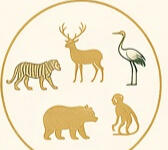
Wu Qin Xi, the "Five Animal Frolics", is traditionally credited to Hua Tuo, a renowned physician of the Eastern Han dynasty (25–220 CE). Drawing on the older Daoyin and breathing practices, he is said to have modelled the movements on the tiger, deer, bear, ape and bird. I studied the standardised Health Qigong version, which the Chinese sports authority launched in 2003 as one of four new forms. It has ten movements, two for each animal.The practice moves between the tiger's power, the deer's ease, the bear's weight, the ape's lightness and the bird's balance. It joins bending, stretching and twisting with steady breathing and calm attention. A 2018 systematic review of 28 studies by Guo and colleagues concluded that Wu Qin Xi may support physical and psychological wellbeing in healthy adults and some clinical groups. The same review notes that methodological weaknesses in most of the studies make firm conclusions difficult.Source: Guo Y, et al. (2018). Evidence-Based Complementary and Alternative Medicine, 2018:3235950. PubMed · DOI
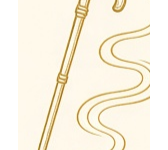
Cane Form (Taiji walking stick)
The cane form I studied is a traditional Taiji walking-stick form whose origins go back to the time of the Boxer Rebellion (1899–1901); it came from China to Taiwan in the 1950s. Bob teaches it within his 7 Stars School of Taijiquan, and he taught it at Leqita in 2025 and 2026 and will teach it there again in 2027. Bob has also taught it beyond the school, for example as a "Tai-Chi walking stick" workshop at an international Taiji meeting in 2001.The walking stick is among the gentlest of Taiji's training implements. A light stick is held and moved with the same principles that guide the empty-hand form: rootedness, relaxation, continuous flow and movement led from the waist. Working with the stick extends attention beyond the hands and asks the whole body to stay connected through its length. Like other Taiji practices, cane work is traditionally valued for cultivating coordination, balance and calm concentration.
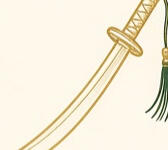
Sabre Form (Taiji Dao)
The Taiji sabre (dao, 刀) is a single-edged, curved blade, one of the classical weapons of Taijiquan; I studied the Yang-style sabre. In this tradition, the sabre set is remembered through a thirteen-line poem of seven-character verses recited during practice. The poem is recorded in Dong Yingjie's Tai Chi Boxing Explained (1948) and in the sabre manual Taiji Dao (June 1959), written by Cai Longyun with Fu Zhongwen demonstrating the form, and its lines carry vivid names such as Seven Stars, Mount the Tiger and Jump the Dragon Gate.Compared with the sword, the sabre has a more vigorous character, with wide cuts and turns and decisive changes of direction. These are still carried by Taiji's soft, connected body mechanics. Practice asks for clear intention, alert footwork and an even breath. It is traditionally valued for developing vitality, coordination and focus within the calm of Taiji movement.
← Back to home · Science library
Knowledge Hub
Honest, sourced articles on breath, sound, resonance and qigong, with every claim clearly labelled by its evidence.
Join
Stay in resonance
Leave your name and email to join the mailing list. You will receive the free Six Healing Sounds Practice Guide, in English and German, then regular news and articles, and hear first when booking for July 2027 opens. No noise, only what serves your practice.
By sending this form, you agree that your details will be used to answer your message. More in the privacy policy.